
Choosing a process
Laminator or flatbed applicator?
A laminator protects a print with film. A flatbed applicator helps align and apply adhesive material to a supported substrate. The right starting point depends on whether your work is mostly rolls, rigid boards or a regular mixture of both.
When most work arrives on rolls.
For banners, display graphics and reel-to-reel output, start by comparing roll-fed Easymount laminators. Record the widest media you actually finish, the film type and typical run length. Check how material is loaded, how the release liner is managed and where finished output goes. A speed specification alone does not describe the whole production cycle.
Film choice matters. Pressure-sensitive cold lamination, heat-assisted application and higher-temperature thermal processes are not interchangeable. Confirm the film supplier's requirements against the exact model's documented temperature range. Easymount Sign Cold and Easymount Air offer different starting points for that comparison.
When board mounting takes the time.
Flatbed application is useful when the task is positioning adhesive graphics or mounting prints to rigid board. Look at board length, width and thickness together, then consider how an operator supports and aligns the material. Published mounting thickness is not a guarantee for every substrate, adhesive or surface.
Do not confuse an application table with a digital cutting table. Mounting joins materials; cutting and creasing change their shape. Easymount Flow is a modular support-table accessory for material entering or leaving an Easymount system, not a table laminator or a replacement for an applicator.
When rolls and boards share the schedule.
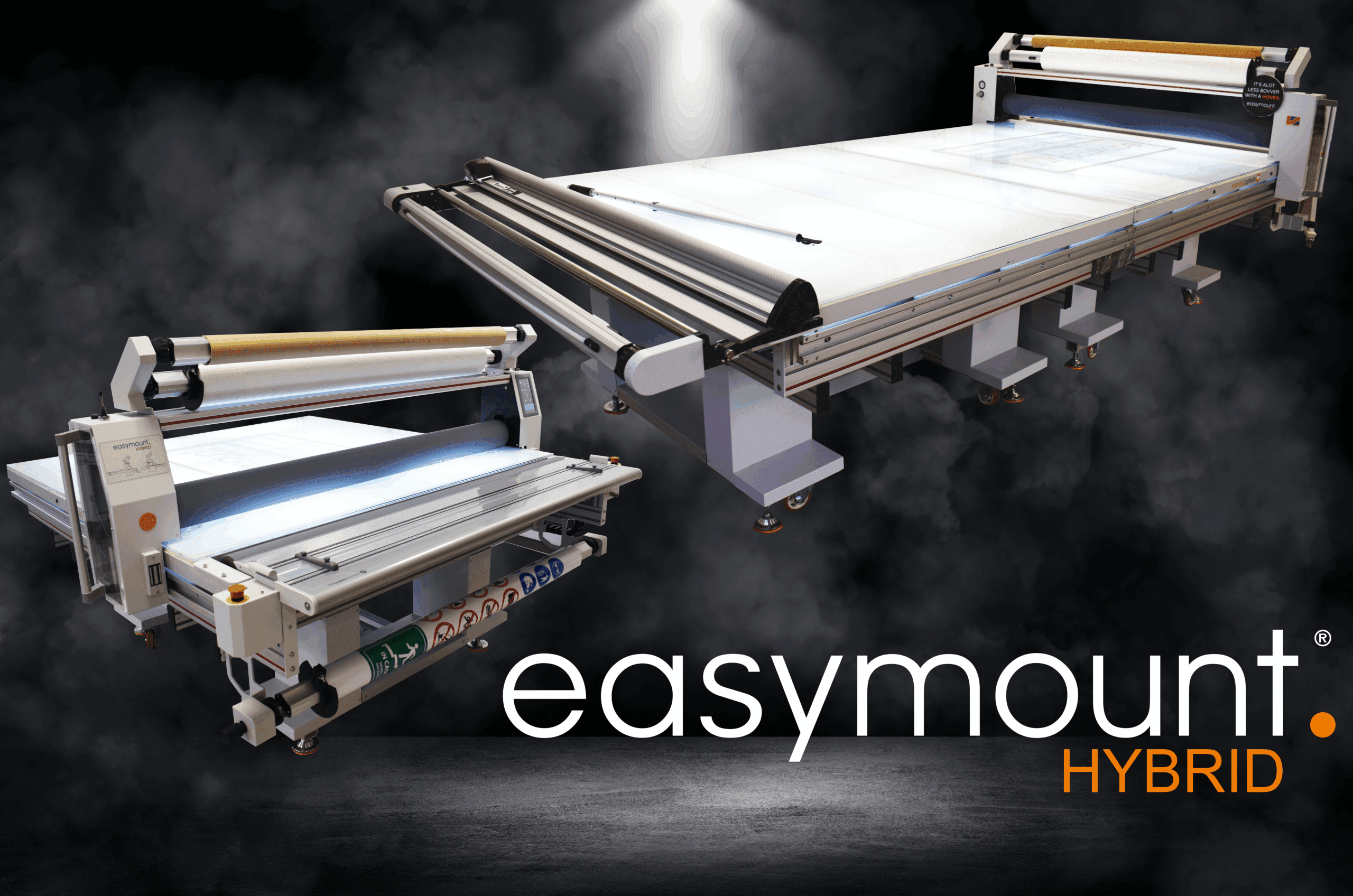
Easymount Hybrid combines a roll-fed laminator and flatbed applicator on one modular platform. Patented HOVER floating rollers support alignment, while electromagnetic locking enables the change between workflows. Compare that arrangement with separate equipment by looking at job mix, changeovers and whether roll work and board work must happen at the same time.
The published Hybrid limits are 1600 mm / 63 in working width, 6 m/min / 20 ft/min laminating speed, 45 mm / 1.8 in mounting thickness and a 0-60 °C / 32-140 °F temperature range. Table lengths start at 1.5 metres and extend modularly. That is a starting table length, not the entire machine footprint. Pneumatic roller pressure requires an air supply.
When the finish is decorative or structural.
For digital foil and decorative print effects, compare Matrix rather than treating a wide-format applicator as an embellishment system. For packaging assembly, VeloTaper supports automated double-sided taping alongside cutting and creasing on compatible VeloBlade Volta+ systems. Zip Core Design is packaging CAD/CAM software, not a laminator.
Bring representative materials and the required finished result to sales. A family recommendation narrows the conversation; it does not establish material compatibility, availability or a quotation. Use the Hybrid installation planning guide to prepare the space and utility questions.